Dark matter detector picks up a mysterious signal
September 1, 2026
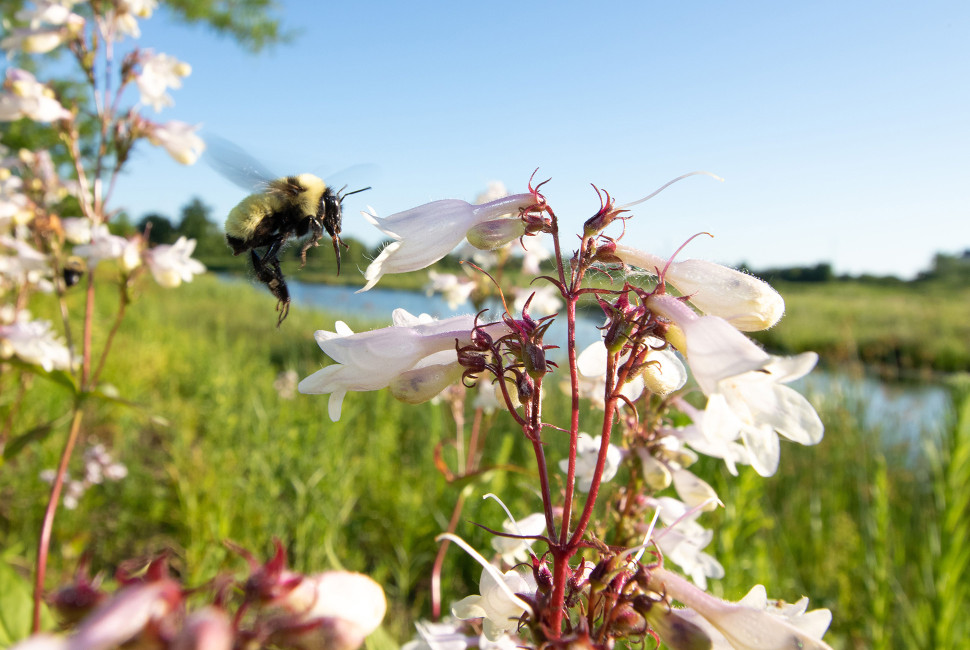
For gardeners who love colorful, tidy flower beds, helping pollinators doesn’t have to mean going fully wild.
A new study from plant biologists at Northwestern University and the Chicago Botanic Garden found that some cultivated plants — bred for their vibrant blooms, compact forms and visually appealing uniformity — can still provide meaningful support for bees, butterflies and other pollinators.
Among the tested plants, cultivated black-eyed Susan (Rudbeckia fulgida ‘Goldsturm’) and foxglove beardtongue (Penstemon digitalis ‘Husker Red’) attracted pollinators at similar rates to their wild counterparts, while others, such as R. fulgida ‘American Gold Rush’ and P. digitalis ‘Blackbeard,’ performed less well.
While conventional knowledge often suggests that native wildtype plants are best for pollinators, the open-access study, published in Ecosphere, reveals a reassuring middle ground. Gardeners don’t have to choose between beauty and ecological value. Instead, a thoughtfully planted mix of wild and cultivated flowers may offer a more approachable starting point for people who are new to pollinator gardening.
“Our findings emphasize that ecological value and aesthetics don’t have to be at odds with each other,” said Chicago Botanic Garden’s Nicholas Dorian, the study’s lead author. “There are many people who might be interested in getting involved in the pollinator gardening movement but feel intimidated. Turning a garden or front yard into a wild space can feel daunting. A key takeaway from our study is that cultivated plants with aesthetic appeal can still bring pollinators into your yard and may be a really nice gateway for people who are on the fence or don’t have time or resources to seek out wildtype plants.”
An expert in residential and urban gardening for pollinator conservation, Dorian is a postdoctoral research associate in the Program in Plant Biology and Conservation, a partnership between Northwestern’s Weinberg College of Arts and Sciences and the Chicago Botanic Garden. The study was co-authored by Imeña Valdes, former Plant Biology and Conservation master’s student who led field data collection efforts at the Chicago Botanic Garden as part of her thesis. This work also was co-authored by former graduate student and manager of Budburst, Jessamine Finch, along with adjunct professors and conservation scientists Paul CaraDonna, Amy Iler and Kay Havens, director of Plant Science and Conservation at the Chicago Botanic Garden’s Negaunee Institute, and Richard Hawke, director of Ornamental Plant Research at the Chicago Botanic Garden.
Although pollinator gardens have been around for decades, the movement accelerated in the mid-2000s — sparked by the alarming decline of honeybees. Now, it is a mainstream movement, with millions of pollinator gardens dotting lawns, parks and roadways across the U.S.
“The pollinator garden movement is a somewhat new approach to the conservation of biodiversity,” Dorian said. “In the 20th century, we thought conservation had to take place in big areas away from people — like in national parks or big preserves. But, more recently, we’ve brought conservation back home. That can mean ripping up your lawn to install a native meadow, planting a pot of flowers on your balcony or collaborating with your neighbors to convert the road median into a garden.”
Traditionally, pollinator gardeners have prioritized native, “wildtype” plants — species that grow naturally in the wild without human breeding — and avoid cultivated varieties, or cultivars. Wildtype plants retain their original traits, which were shaped in part by thousands of years of evolution to attract pollinators. Cultivars, on the other hand, are bred not to attract pollinators but to appeal to people. This has led many people to assume that cultivars wouldn’t attract pollinators.
“These days, there is an overwhelming interest in gardening for pollinators,” CaraDonna said. “One of the most frequent questions we’re asked is ‘which plants are best for pollinators?’ Somewhat surprisingly, there’s not a lot of science behind pollinator gardening guidelines, including which plants are best for pollinators.”
To help close this gap in knowledge, Dorian, CaraDonna and their collaborators compared how well wildtype plants and cultivars attract pollinators. The study included both controlled experiments at the Chicago Botanic Garden and crowdsourced observations from volunteers across the eastern U.S.
In the controlled experiment, researchers planted four native plant species alongside 13 cultivated varieties in the same plot. Throughout a two-year period, trained ecologists observed each individual plant for 10-minute periods, three times per week. During each observation, they counted the number of insects — including bumble bees, honeybees, butterflies, moths, beetles and others — that visited the flowers’ reproductive features.

To explore whether their results extended beyond a single garden, the research team turned to the public. Through a five-year community science project, volunteers planted the same flowers in backyards, schoolyards and public spaces, and then tracked pollinator visits using the standardized 10-minute observation method.
The combined results revealed a clear pattern. While the researchers did confirm that wildtypes are consistently the most attractive to insects, cultivars sometimes performed just as well — depending on the variety. Some varieties of black-eyed Susan, beardtongue and aromatic aster attracted pollinators at similar rates to wild plants. But others drew significantly fewer visits.
“None of the plants were completely ignored by insects,” Dorian said. “Wildtypes always had the highest visitation in our study, but some of the cultivars also performed similarly to wildtypes. That means cultivars shouldn’t be dismissed as having no value. That being said, not all cultivars are created equally. Some did underperform compared to the wildtype, and I think that helps to explain why cultivars tend to get a bad reputation among native plant gardeners.”
But even low performers attract more pollinators than lawn grass, which offers virtually no food. That means cultivars, while not perfect substitutes for native plants, can be a useful complement to wildtypes in pollinator gardens. This insight is especially useful because wildtype plants can be difficult to find, while cultivars are widely available at most nurseries and garden centers.
“If you’re trying to attract insects to a green space and all you can find is one of the cultivars that we evaluated, it’ll be certainly better than turf grass,” Dorian said. “It can attract insects and bring them out of hiding.”
Dorian and CaraDonna emphasize that their study’s findings apply to pollinator gardens and not to ecosystem conservation and restoration projects (where cultivars should not be used). They also underscore that they only studied 13 cultivars and do not have enough information to recommend cultivars that were not included in the study.
“Importantly, none of the cultivars in our study exhibited extra petal production, known as ‘doubled flowers,’” Dorian said. “Those cultivars are best avoided for pollinator-friendly gardens. It’s also important to add that cultivars should never be used for ecological restoration projects. Because cultivars are propagated in a greenhouse, we don’t know how they will interact with wild species.”
Next, the team aims to evaluate a broader range of plant varieties and to better understand which floral traits, such as color and height, drive pollinator preferences. And they hope to continue building support for the pollinator gardening movement.
“We want to empower people to feel they have agency over the future of biodiversity where they live,” Dorian said. “By providing evidence for how anyone can attract and support insects in their own yard, we’re hoping to help keep up the momentum of this really exciting movement to do conservation at home.”
The study was partially supported by the National Science Foundation and The Negaunee Institute for Plant Conservation Science and Action.