Northwestern invests in the future of discovery
October 13, 2026

The Northwestern community and city leaders gathered in Thorne Auditorium last week to commemorate the centennial of the University’s Streeterville campus, which is home to several of its professional schools.
In 1926, Northwestern purchased nine acres in the Chicago neighborhood and began building a new home to unify its professional schools, which had been scattered across the city. The expansion cemented a lasting and fruitful relationship with the City of Chicago — anchoring critical work in medicine, law and business.
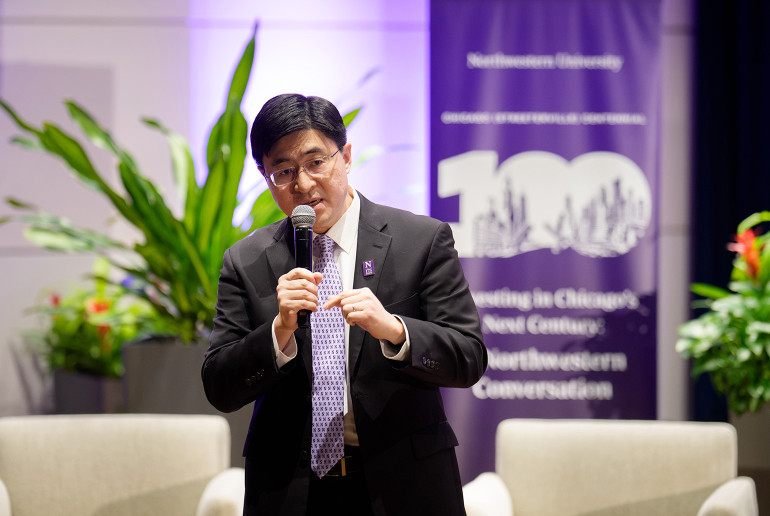
Northwestern President Mung Chiang spoke to the historical collaboration between the University and the City of Chicago.
“In the past 100 years, we have been here to serve the people of Chicago, the communities of Chicago and the businesses of Chicago,” he said. “As we look ahead into the next 100 years, we want to do more. Northwestern wants to be a part of job creation, economic vitality, startups, talent acquisition and much more. Let’s do that together. Chicago looks good in purple.”
“Today, Northwestern is part of the fabric of this city,” said Zachary D. Clopton, Daniel Hale Williams Professor of Law and dean of the Pritzker School of Law, which hosted the event. “Our schools drive scientific advancements that benefit the public, generate tremendous talent, improve public health and influence the systems that turn the wheels of this great city and the world beyond it.”
Northwestern’s influence on Chicago is undeniable — Medill’s Local News Initiative and integration into Chicago’s media ecosystem; Feinberg as the largest research program in the city; the nonprofit work of Kellogg alums; and the law school’s Bluhm Legal Clinic as the catalyst for Illinois’ abolition of the death penalty in 2011 are just a few examples of the University’s citywide impact.
“I’m in awe of the intellectual firepower that we have gathered here to talk about Northwestern and Chicago,” said Northwestern Provost Erik Luijten during the first panel discussion on a century of collaboration. “It’s fantastic to have this source of education, of leaders, that can directly benefit the city.”
Influential Chicago business and civic leaders of investment and philanthropy expressed how their own endeavors have benefitted from their collaboration with Northwestern — and they hope to see more.
Derek R. B. Douglas, president of the Civic Committee and the Commercial Club of Chicago, opened the second panel on building the next century by emphasizing the need for a strategic framework for the future of the city.
“We need to think about the future of Chicago and the region anchored around this notion of growth — economic growth, population growth and innovation — but also in a way that is inclusive,” Douglas said. “My personal view is that if we’re going to be successful in that, we need institutions like Northwestern at the center.”
The love for Chicago was palpable, and business leaders made room for genuine conversations around the city’s growth potential. As the community looks to the future, business leaders said individuals need to work together make Chicago economically viable again.
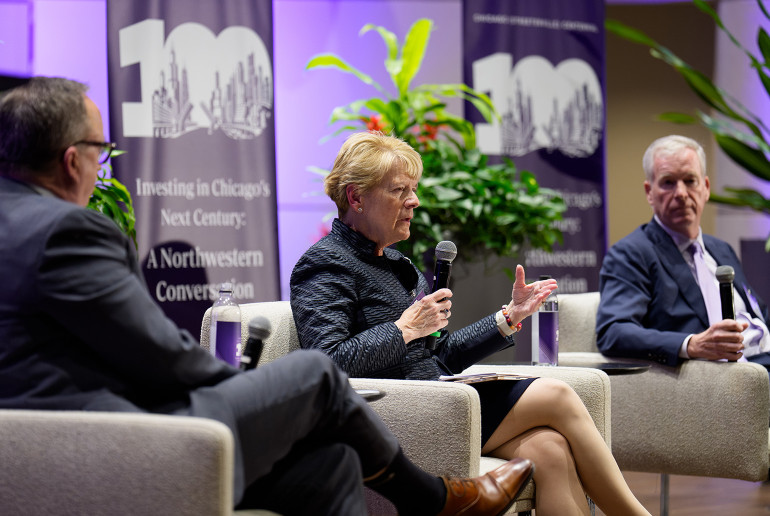
“Number one, you have to attract the very best talent. To do that, you have to have a community that is welcoming and diverse,” said Steve Cahillane ’87, CEO of The Kraft Heinz Company and a Northwestern trustee. “People are building their lives, so you need great schools that will make their children competitive [in the job market]. You must have safe streets. You want a vibrant community with great theatre, great culture and great restaurants. I love Chicago. I’ve made a life here, and there’s a lot that this city has to offer, but we cannot take it for granted.”
The leaders believe the continued growth of Chicago over the next 100 years lives in making sure all Chicagoans are a part of that story.
“As a city, we need to find solutions to deal with the inequality and the segregation that exists in Chicago,” Douglas said. “That’s going to require economic development, redeveloping talent and skills, investing in untapped talent that exists in those communities. It’s going to involve universities finding ways to partner with city colleges and others to try to address that. It’s in everyone’s interest, both civic and business. We need to maximize the potential of all corners of the city. If we’re able to do that, Chicago’s going to be unstoppable.”
As Northwestern moves into its new era, President Chiang reiterated his dedication to making sure the University is at the center of the Chicago comeback.
“We cannot walk this alone,” he said. We’re going to lean on the civic, business, nonprofit, artistic and educational communities in the city we call home.”