Northwestern invests in the future of discovery
October 13, 2026

How do you constructively engage with someone you find morally reprehensible? A case in point is the central figure in “Vigil” by George Saunders, Booker Prize winner and #1 New York Times bestselling author. Saunders imagines the final hours of K.J. Boone, an oil tycoon on his deathbed. Boone is visited by Jill “Doll” Blaine, a spirit who tries to comfort him, and a parade of other spirits, including Jacques, inventor of the combustion engine, who pushes Boone to confront the harmful consequences of his ambition.
“Vigil” is the inaugural selection of the Litowitz Center for Enlightened Disagreement’s new Campus Reading Program. During the introduction to the program’s keynote conversation, Litowitz Center faculty co-director Nour Kteily said he founded the Center with faculty co-director Eli Finkel based on the premise that “conflict is not a bug to be fixed, but a strength to be harnessed.”
The Campus Reading Program extends the Center’s mission by introducing the wider campus community, particularly undergraduates, to themes, research and theories of enlightened disagreement.
Radical empathy is a form of power.”
“We know, of course, George didn’t set out to write this book for us, but on a page-for-page basis, this slim novel is as much about enlightened disagreement as many works of nonfiction,” Kteily said.
During the Nov. 19 keynote event at Cahn Auditorium, Finkel and Saunders discussed “Vigil” through the lens of enlightened disagreement.
Saunders said Boone’s character was based on ExxonMobil CEO Lee Raymond, who once delivered an address that has been characterized by environmentalist Bill McKibben as the “most irresponsible speech” ever given by an American. Despite having possession of scientific facts about the damaging and potentially catastrophic aspects of the industry, Raymond chose to deny it in his speech.
“I’ve worked for many people like him,” Saunders said. “I was in the oil business and worked with gruff, heart-of-gold people who, when you needed them, would come through for you. And when they needed to, they would squash you. But I wouldn't have written about him if I couldn't summon up some affection.”
To broaden his point, Saunders shared “a brilliant comment” made by a Northwestern student he met earlier in his visit who observed that part of the problem with fiction is the author controls the sympathy which the reader is feeling towards the bad character. “So, it’s a question of how to imaginatively represent somebody that you don’t like without either making him a caricature or making him into a falsely good person whose essential sin is hidden in this kind of haze of good feelings,” Saunders said.
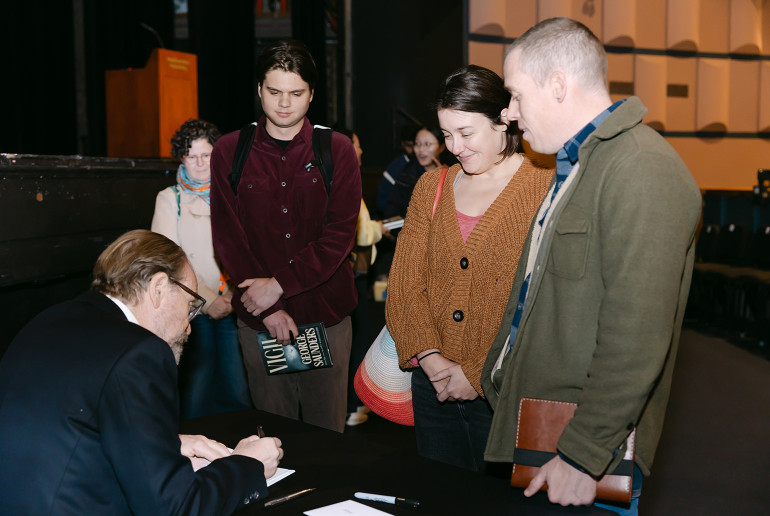
Finkel said the Litowitz Center is most interested in understanding how to make the moral disagreements people feel most passionately about more productive.
He quoted from “The Brain-Dead Megaphone,” an early Saunders essay: “Every pen stroke in a document under revision is the antidote, to false certainty,” adding, “I think it’s a way to make intellectual and moral humility concrete — because revision is a way that we can go back through our belief system and find out where we got it wrong. But as we step away from the page to the world, where there are real stakes, how can we act and feel we are being fair to the other side?”
“Radical empathy is a form of power,” Saunders said. “There are times we have to act, and if we can imagine the mind of our opponent three-dimensionally, we can see how an idea seems great to them. In fiction we can do this impossible mission. In the real world, it may not be possible. Can I believe you are as real as I am? I can’t. I don't. But I know it’s true. I know what you're saying. In the real world that’s what social action is about — imagining your enemy to be as real as you. In real life, you can come close and that’s all power.”
Alyson Carrel, a professor at Pritzker School of Law, attended the keynote. She said the discussion of “Vigil” aligned with many of the concepts in “The Perspectives Project,” a course she teaches for incoming first-year law students.
“Saunders talked about the importance of curiosity,” Carrel said. She recounted his example of climate scientist Katharine Hayhoe, who observed that if you go with good intentions and 10 solid facts to a skeptic of climate change, they may only hear “You’re wrong” or “You’re stupid.”
“Saunders also pointed out the importance of relationships. Sometimes it isn’t just what we say or how we say it, but who we are in relation to the other person. Within a trusting relationship, we can hear hard truths. My biggest takeaway is that curiosity and relationships work together. Genuine curiosity about the other person helps build connection and trust, and that trust, in turn, opens up pathways to deeper curiosity, empathy and understanding,” Carrel said.
Saunders’ visit included conversations over meals with students in the Litowitz Center’s certificate program in enlightened disagreement and undergraduate and graduate students in creative writing, including those in the Litowitz graduate programs in creative writing and English.
Weinberg College student Katherine Zang ’30 is in the certificate program. She said attending dinner with Saunders and the keynote was “probably the happiest moment of this quarter.”
“When I read ‘Vigil,’ one of the biggest questions for me was how to balance empathy with moral accountability,” Zang said. “Jill’s infinite but ineffective empathy made me wonder how much empathy we should extend to people who have done terrible things. Saunders suggests there may be no true divide between compassion and firmness. We can disagree with some power without resorting to violence. This gave me a deeper understanding of ‘enlightened disagreement,’ namely that we can remain curious about how people came to be who they are without surrendering moral judgement.”
The Litowitz Center is currently accepting book recommendations for the 2027-2028 Campus Reading Program. Submit using the online submission form by Monday, Nov. 30.