Dark matter detector picks up a mysterious signal
September 1, 2026

This is the first of a two-part feature on quantum biology. In the second part, Songi Han and Michael Wasielewski will discuss the future of the field.
What if some of biology’s longest enduring mysteries — from how birds navigate their thousand-mile migrations to how plants turn sunlight into energy — depend on the strange rules of quantum mechanics?
That question lies at the heart of quantum biology, an emerging field that explores whether living systems harness quantum phenomena at the level of electrons, atoms and molecules.
This new field will take center stage next week as Northwestern University co-hosts the Quantum Effects at the Biology and Innovation Interface (QBi2) 2026 consortium, a quantum biology workshop for both researchers and students.
The workshop, held Oct. 19-20 at the Biohub in Chicago, will focus on photoactive proteins — or proteins that respond to light — and how their quantum properties might be observed, controlled and ultimately used to better understand living systems.
Northwestern Now spoke to chemistry professors Songi Han, who co-organized the consortium together with Peter Maurer at the University of Chicago, and Michael Wasielewski, director of Northwestern’s Institute for Quantum Information Research and Engineering (INQUIRE), which will sponsor the event.
During their conversation, Han and Wasielewski discussed what quantum biology actually means, why the field remains controversial and how their own collaboration bridges quantum science and biology.
Han is the Mark and Nancy Ratner Professor of Chemistry in Northwestern’s Weinberg College of Arts and Sciences and the vice chair of the American Chemical Society’s physical chemistry division.
Wasielewski is the Clare Hamilton Hall Professor of Chemistry within Weinberg and director of the Center for Molecular Quantum Transduction (CMQT).
What is quantum biology?
Songi Han: Quantum biology is shorthand for quantum effects in biology. Over time, I have learned that people are very emotional about this term — either passionately in favor of it or very against it. It comes down to a distinction between quantum for biology and quantum in biology.
Quantum for biology means using quantum sensing to better understand and interrogate biology, and I think that portion is absolutely solid. There’s nothing to argue about. The part that people get passionate about is quantum in biology, meaning quantum effects that actually drive biology.
I happen to believe there are many instances where quantum effects play a big role in biology, but that’s up to us to investigate. The most famous example is bird navigation.
Undoubtedly, when birds are born, they know what to do. They fly 5,000 miles in one direction and know how to come back. It’s such a dramatic phenomenon. Even though it is not entirely clear how it works, that’s one of the reasons why there’s no denying that quantum effects play a role in biology.
Michael Wasielewski: I agree with Songi. Depending on who you talk to, it can be a controversial field, but there are solid areas that are demonstrable. That’s the important part. Photosynthesis has a lot of processes that are influenced by quantum effects, including one of the original quantum biology proposals: how energy migrates through proteins during photosynthesis.
For 50 years, we have known that electron spins are involved in converting light energy into stored charges. These processes are well-established examples of quantum processes in biology. The theory of avian magnetic reception is an offshoot of that because the same light-driven processes that generate coherent spin pairs, i.e. pairs whose properties remain linked, are involved as well. The missing piece of the puzzle, however, is how sensitivity to Earth’s magnetic field gets amplified and converted into a signaling process that actually tells the bird where to go. That part is still largely missing. So, on a molecular and protein level, we understand quite a bit, but how that gets translated into biological function is still a mystery.
In what way is this a controversial field?
Wasielewski: Let me give you one specific example. When I give popular lectures, people frequently ask about quantum consciousness. I have to be very diplomatic in my responses to members of the general public, because basically there’s not a shred of evidence that consciousness is based on a quantum process. But that doesn’t mean it isn’t.
Han: I think the reason why this field is gaining popularity now — even though studies of bird navigation have been going on for 70-plus years — is because we have better tools and technology to measure these effects. I personally, secretly believe in quantum effects in biology, but as a physical chemist and scientist, I know it doesn’t matter what I believe. We need to be able to measure them. We now have powerful tools that could help us demonstrate these effects unambiguously. It’s always step by step. The technology and questions are now meeting.
How do you do experiments with biological systems in quantum?
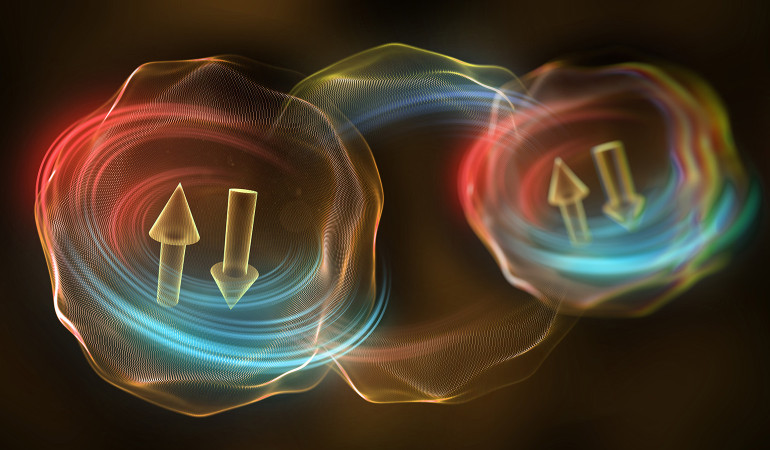
Wasielewski: It depends on what quantum property you want to look at. For instance, Songi and I both have an interest in electron spins. When you look at optical properties like light absorption, emission and energy transfer, the timescales get very short. Maintaining quantum coherence becomes very challenging.
A lot of quantum research is performed at ultra-low temperatures because researchers want to put the system in a very specific quantum state. They cool it down so that the spins, perhaps in superconducting materials, are all pointed in the same direction with minimal outside influence.
If you shine light on the system, you can generate a quantum state very rapidly and then look at it and manipulate it. In those circumstances, you don’t necessarily need ultra-low temperatures.
Han: I have a very exciting system where a protein converts light into mechanical action. A magnetic field — and presumably an electric field — can control a chemical process within that system. We discovered it with tools that we have, but now we want better time resolution.
These decisions in biology don’t have to last forever. They can happen in a microsecond. What counts as “fast” or “slow” depends on what biological process you’re interested in. As Mike said, an electron spin only needs to maintain coherence long enough to influence the processes we’re interested in. For something like chemical bond formation, one microsecond might be long enough. The system is essentially making a decision: Should I go forward and form the bond, or should I go backward and not make it?
We want to capture that process using transient EPR, or transient electron paramagnetic resonance, which uses a fast laser to observe these fleeting states. Time-resolved measurements aren’t traditionally what my lab does. That’s Mike’s expertise. This is one reason I’m excited to work with Mike. We can combine our expertise to tease out those processes.
How did you two start working together?
Han: Mike is well positioned in quantum information. I come more traditionally from magnetic resonance, electron spin resonance and nuclear magnetic resonance [background]. I don’t think five years ago I would have said I was doing anything related to quantum sensing.
But I have always pushed the boundaries of sensitivity and explored ways to read out electron spin using nuclear spin and vice versa. It turns out that because of the tools that I have developed, especially for studying biological systems, it’s a relatively exciting and natural extension into quantum science. I’m coming at these questions from a different angle, with a different instrument. Mike is coming at them with a different timescale.
Wasielewski: Songi is absolutely right. Our expertise is in time-resolved spectroscopy — going from ultra-fast to longer timescales — and we do time-resolved magnetic resonance as well. And so consequently, there’s a natural combination of interests and capabilities. I also was one of the folks who was instrumental in convincing Songi to come to Northwestern.
Han: He’s the reason I’m here.
Wasielewski: It’s delightful to have her as a colleague, and we’ve talked a lot about doing things together. We’ve now published a paper together, and we’re proposing projects together. I think there’s a lot of synergy there that we can take advantage of.
Han: We are scientifically excited about similar questions and have complementary tools. Mike is leading INQUIRE and CMQT. I started a quantum biology workshop series that launches this month, and we’re already getting ready for Quantum Week next year. If we really focus on it and make sure we capture this moment, we have a leg up because we have developed these tools for decades. We’ve thought about these questions for a long time, and this is a time when things can come together.