Dark matter detector picks up a mysterious signal
September 1, 2026

· An international collaboration of scientists, including a Northwestern University physicist, has found the most compelling hint of elusive dark matter to date.
For the better part of a century, researchers have tried to understand dark matter, an invisible material that comprises roughly 85% of the universe’s total matter. But because scientists have never directly detected it, they have struggled to determine exactly what it is.
Now, a new analysis from the LUX-ZEPLIN (LZ) experiment has recorded a single particle interaction that researchers cannot explain with known background signals from normal matter. Although the team does not claim it found dark matter, it estimates there is just a 0.5% chance the anomalous event came from a known source.
The study authors recently presented the work at the 2026 TeV Particle Astrophysics conference in Japan and will submit the paper to Physical Review Letters. A pre-print of the paper soon will be available on arXiv.
“In the 20 years that I’ve been involved in the search for dark matter, this is the most interesting single event that I’ve seen,” said Northwestern’s Eric Dahl, who co-authored the study. “Over the past year, we have spent a lot of time poring over ways to explain this event. After doing the math, we haven’t found anything with even a 1% chance of creating something like this signal.”
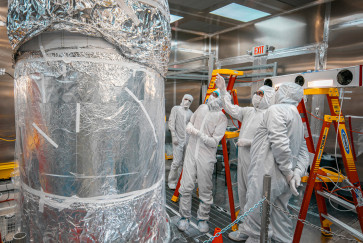
An expert on dark matter detection, Dahl is a professor of physics and astronomy at Northwestern’s Weinberg College of Arts and Sciences and member of the LZ collaboration, which comprises 250 scientists and engineers from across 39 institutions. LZ’s detector is managed by the U.S. Department of Energy’s Lawrence Berkeley National Laboratory (Berkeley Lab) and operates nearly one mile below the ground’s surface at the Sanford Underground Research Facility (SURF) in South Dakota.
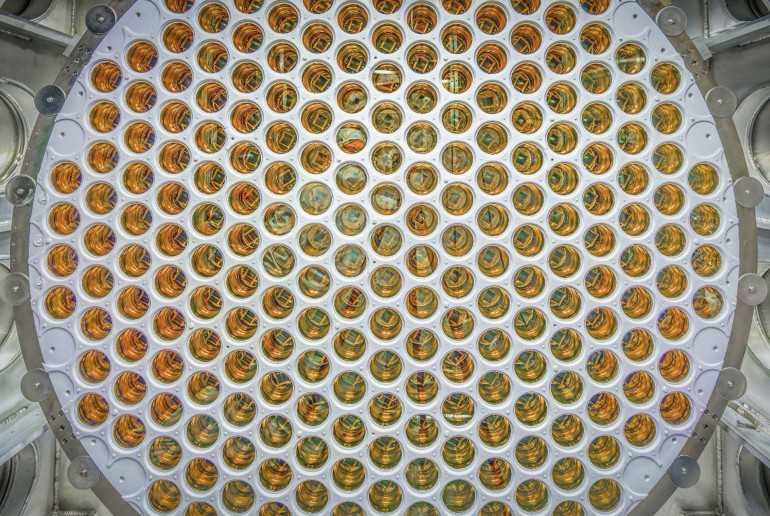
Members of the LZ collaboration search for dark matter by looking for signature flashes of light from energy deposited inside its detector, which is filled with 10 tonnes of ultrapure liquid xenon. A noble gas, xenon condenses into liquid when cooled to temperatures below -108 degrees Celsius.
“We know that we’re always surrounded by dark matter. It’s passing through us all the time,” Dahl said. “We’re looking for a dark matter particle in the detector to bounce off one xenon atom. That’s our signal. It’s like if you’re watching a table of pool balls. Then, an invisible cue ball collides into one of the balls. We can’t see the cue ball, but we know it’s there because the other balls start bouncing around. Something had to hit them.”
When a particle interacts with liquid xenon, it transfers energy to xenon atoms, producing two detectable signals. First, excited xenon atoms release a brief flash of ultraviolet light. The interaction also knocks electrons free. An electric field pulls those electrons upward through the liquid and into xenon gas, where they produce a second flash of light. By measuring these two pulses, researchers can learn about the particle interactions that produced them.
In the LZ experiment, researchers hunted for a broad range of weakly interacting massive particles (WIMPs), a hypothetical type of dark matter particle. In the simplest WIMP models, a dark matter particle would deposit only a tiny amount of energy when colliding with a xenon atom.
But the anomalous event deposited far more energy than that — making it unusual for a conventional WIMP interaction, while still potentially consistent with more complex models of dark matter. If a WIMP caused the anomalous event, its mass would likely be at least 200 times the mass of a proton.
“If a dark matter particle struck a xenon atom in our detector, we would expect the particle to give the atom a tiny ‘kick,’” Dahl said. “It’s not much, but it’s enough that we can see the xenon atom recoil. For the simplest interactions we look for, we would expect that recoil to carry about as much energy as a single X-ray photon. But in this particular event, we see a lot more energy than that. That means, if this is dark matter, dark matter could be more interesting than the simplest thing we could have imagined.”
Although the event is unusual, researchers cannot yet rule out the possibility that it came from a background source. To lower those odds, the researchers initially built the experiment to keep it highly fortified from the outside world. For example, they built the detector inside a water tank at the bottom of a former goldmine, where one mile of thick rock overhead shields the site from cosmic rays from space. Outer detectors also protect the central detector from background neutrons. From there, a suite of computational tools helps disentangle particle interactions and reject activities that might mimic dark matter.
At Northwestern, Dahl and his team worked to distinguish a potential WIMP from ordinary, known phenomena that can create signals resembling a dark-matter interaction. These background signals can come from multiple sources, including radioactive decay in the detector materials or the xenon itself.
“My group has spent a lot of time tracking radon in the detector,” Dahl said. “Radon is a naturally occurring radioactive gas that often builds up in basements. You can get radon at much lower levels inside the detector, and some of our largest backgrounds come from ways the radon radioactive decay chain can mimic a dark matter signal.”
A definitive detection would solve one of physics’ most enduring mysteries while providing the most concrete evidence yet of new physics beyond the Standard Model. Dahl emphasizes that the new result is based on only one-quarter of the data that LZ will collect during its lifetime.
With additional data, the team could find evidence that either strengthens or weakens the possibility that they finally found dark matter. Already, LZ had accumulated the world’s largest dark matter dataset and will continue to accrue search data, substantially improving search statistics.
“When this field was getting started, we frequently found that we hadn’t thought of everything a detector could do to trick us,” Dahl said. “Our understanding of these detectors is much, much better now, but it’s still possible that we’ve found something that only looks like dark matter — something that we weren’t creative enough to think of ahead of time. I don’t think anybody in the field would try to claim a discovery based on one event. We have to continue to collect more data and analyze more data.”
LZ is supported by the U.S. Department of Energy (DOE), Office of Science, Office of High Energy and Nuclear Physics and the National Energy Research Scientific Computing Center, a DOE Office of Science user facility. LZ also is supported by the Science & Technology Facilities Council of the United Kingdom; the Portuguese Foundation for Science and Technology; the Swiss National Science Foundation; the Australian Research Council Centre of Excellence for Dark Matter Particle Physics; and the Institute for Basic Science, Korea. Thirty-nine institutions of higher education and advanced research provided support to LZ. The LZ collaboration acknowledges the assistance of the Sanford Underground Research Facility.