Dark matter detector picks up a mysterious signal
September 1, 2026

Meet three Northwestern scientists who are reshaping how we think about the ovary — not simply as a reproductive organ, but one of the body’s earliest-aging tissues — and identifying molecular targets that could one day slow its aging.
Women’s health is having a moment.
From ads about platelet-rich plasma injections or longevity peptide therapy to influencers peddling herbal supplements for hot flashes and brain fog, the anti-ovarian-aging and menopause content is seemingly everywhere for women in midlife.
Regarding the increased attention on women’s health, reproductive scientists at Northwestern University Feinberg School of Medicine are concerned it can often be misguided, focused on the wrong things and unsubstantiated.
One key takeaway: The ovary is far more than simply a repository for eggs. It is a dynamic organ that produces hormones, communicates with the rest of the body, undergoes aging-related changes and influences women’s health long after its reproductive capabilities have expired.
Ovarian aging is defined by the loss of egg quantity and quality that occurs throughout a woman’s lifetime and has impacts on fertility, hormone function and overall health. Reproductive function begins to decline in women in their mid-30s and ceases completely at the time of menopause. Despite the fact that reproductive aging occurs in women when they are otherwise chronologically young, ovarian aging is still aging.
However, for decades, fertility and menopause experts, reproductive scientists and aging biologists, and other specialists have examined different aspects of the ovary, often in isolation. And girls have learned about their ovaries in the context of periods and pregnancy but haven’t received much information about the influence ovarian hormones have on their bone, heart and brain health as they age.
“One of the big problems that has hindered women’s health is this separation of reproduction and ovarian function, and I think we have to shift that discussion so that it’s across the lifespan,” said reproductive aging scientist Francesca Duncan. “There needs to be more organic interactions among clinicians and scientists who are treating patients or studying biology, respectively, throughout the continuum of women’s health.”
Now, a unique collaboration among Northwestern physician-scientists and basic researchers, including Duncan, is bringing those perspectives together to study the ovary more holistically. They’re uncovering how ovaries age, developing ways to measure that process noninvasively and identifying molecular targets that could one day slow it.
The egg has been the star of the show for much of modern reproductive biology.
In fact, Duncan built her career studying eggs, which she calls the most important cells in the body because “they give rise to the next generation.” Then her lab made a serendipitous discovery: As ovaries age, they accumulate scar-like fibrotic tissue and inflammation that can impair ovarian function. Suddenly, Duncan found herself less interested in the egg itself and more interested in the tissue surrounding it.
“It completely derailed me in a good way,” said Duncan, an associate professor of obstetrics and gynecology in the division of reproductive science in medicine at Feinberg.
The finding spurred a broader shift in the field. Researchers are increasingly recognizing that aging affects not only the eggs housed within the ovary but also the ovarian environment that supports them. In February, a paper published in Science from scientists in China validated and extended Duncan’s earlier findings about ovarian fibrosis from mice to humans and into clinical practice, which she sees as a major advance for the field. The intensifying focus on this area of research is vital because the ovarian microenvironment may influence fertility, menopause, cancer risk and potentially broader health outcomes, Duncan said.
Duncan’s latest work has pushed that idea even further. In a study published in June, her lab found the post-reproductive ovary in older mice appears to transform into something resembling an immune organ, producing inflammatory signals long after reproduction has ceased.
“I’m obsessed with this concept that the post-reproductive ovary is not defunct,” Duncan said. “It is definitely doing something, but what, we’re still not sure of. I think that’s where we’ll see huge developments in the next 10 years.”
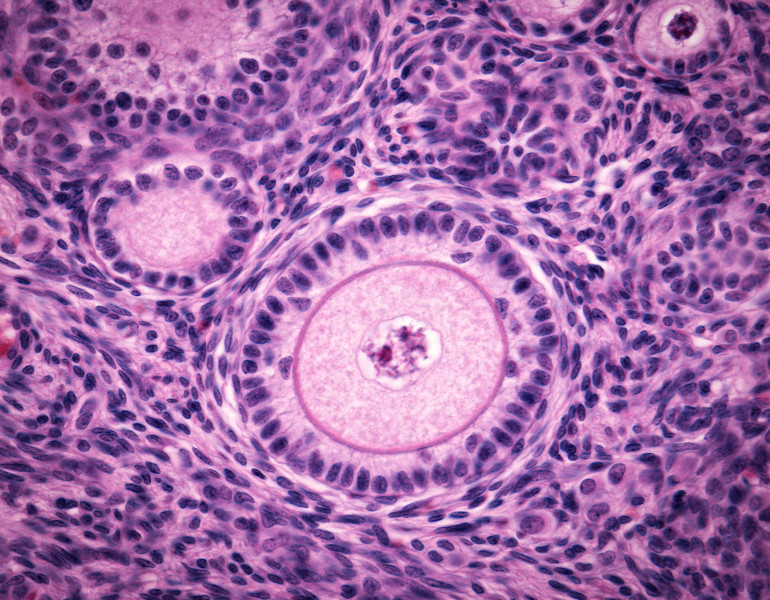
Measuring the biological age of women’s ovaries could be the elusive key to unlocking longer health spans — the length of time a person remains healthy and free from serious illness or chronic diseases. Since the ovary ages earlier than other organs, it may provide a glimpse into a woman’s future health, predicting when she’ll go through menopause, optimizing when hormone treatments can begin and determining her risk of disease.
The challenge to measure this biological process has brought together researchers like Duncan and Dr. Elnur Babayev, who are collaborating to noninvasively examine in humans how the mechanics of the ovary change with age. They’re doing so by adapting technology commonly used to evaluate liver fibrosis to measure ovarian stiffness using ultrasound, and combining advanced imaging, molecular profiling and single-cell analyses to identify measurable signs of ovarian aging in humans. Duncan’s team also is pursuing a blood test that could reveal fibrosis, tissue health and ovarian-aging status.
“We’re collaborating to not just study things in mice or in the lab dish, but actually bring it to our patients,” said Babayev, an assistant professor of obstetrics and gynecology in the division of reproductive endocrinology and infertility at Feinberg and a Northwestern Medicine physician.
Together, the projects represent an emerging effort to move ovarian aging from an abstract concept to a quantifiable biological process. To that end, the scientists argued in a June 2025 Nature Medicine commentary piece that to truly transform reproductive medicine, public health and research into women’s health, ovarian aging should be recognized as a formal diagnosis, akin to how the field of obstetrics adopted the concept of “advanced maternal age.”
“Ovarian aging is a major, yet under-recognized, contributor to sex-based disparities in aging-related diseases — driving higher rates of Alzheimer’s disease, dementia, cardiovascular disease, metabolic dysfunction, osteoporosis, impaired tissue repair and depression among women after midlife,” they wrote in the piece.
Identifying changes that accompany aging is only the first step. The next challenge is determining which biological pathways are actually driving the decline. Dr. Kara Goldman is one scientist pursuing those drivers.
She came into women’s health by way of cancer. Having watched her mother undergo cancer treatment at Northwestern, Goldman later became fascinated with helping young cancer patients preserve their fertility. Watching these women undergo treatment helped her see huge gaps in modern medicine.
“The standard of care to preserve fertility is to freeze eggs or embryos, but we’re doing nothing to protect women’s ovaries,” said Goldman, now an associate professor of obstetrics and gynecology in the division of reproductive endocrinology and infertility at Feinberg and a Northwestern Medicine physician.
That observation led her to a broader insight: infertility is only the most visible consequence of chemotherapy-induced ovarian aging. The mechanisms causing chemotherapy-related infertility are leading to the aging of an entire organ whose influence extends to the brain, heart, bones, metabolism and overall health.
Today, Goldman centers her research on a cellular signaling system called the mTOR pathway, which plays a critical role in women losing eggs as they age or during cancer treatment. In 2017, she found mTOR inhibitors, which block that cellular signaling, preserve ovarian function and fertility in mice undergoing chemotherapy. Goldman also studies cumulus cells — support cells surrounding eggs that are typically discarded during egg-retrieval procedures during IVF — she calls a “treasure trove of material to understand how the egg is living in its environment.”
Meanwhile, Babayev’s lab investigates the underlying biological mechanisms in animal models. His team has studied pathways such as JAK-STAT signaling, which it found gets dysregulated, or changed, with increasing age in mice. They are working to determine whether these changes are merely markers of aging or actual drivers that could be targeted with therapies.
Biomarkers that Duncan is developing in her lab could someday identify ovarian aging earlier and more precisely. Meanwhile, the pathways Goldman, Babayev and others are investigating could reveal therapeutic targets.
The long-term goal is not simply extending fertility, the scientists say. It’s preserving ovarian function itself and potentially promoting healthier aging more broadly.
“I think we are closer than ever to having therapeutics for ovarian function,” Duncan said.
For all three scientists, the implications extend far beyond reproduction. “The number one thing we’re still educating people about is that ovarian aging is aging,” Babayev said.
Ovarian decline begins decades before many women experience the chronic diseases often associated with aging. One way the scientists are getting ahead of that is by collaborating with the Potocsnak Longevity Institute at Northwestern to study cohorts of women with accelerated ovarian aging to understand opportunities for disease prevention.
Goldman sees the issue partly as one of knowledge and empowerment.
“Most women will say that maybe they have some education about contraception, they have less education about infertility, but then when it comes to their post-reproductive years, it’s a black box,” Goldman said.
The deeper question, she said, is whether women should simply accept ovarian decline as inevitable.
“If there’s a safe way to slow that decline of ovarian function so that we can stay healthier for longer, and we’re at a lower risk of osteoporosis and cardiovascular disease, then we should be studying that,” Goldman said.
For Duncan, that possibility is what makes the current moment so exciting.
“One of the most important things now is that we are really at the precipice of finding solutions to ovarian aging in a lab and, within 10 years, changing clinical practice,” she said.