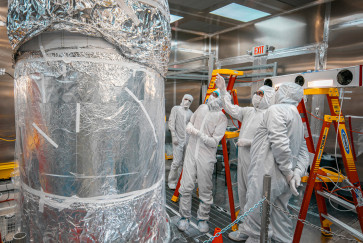
Dark matter detector picks up a mysterious signal
September 1, 2026

Northwestern University scientists and physicians are raising concerns about two proposals currently under review by the Federal Communications Commission (FCC) that could dramatically increase artificial light at night — potentially disrupting sleep, circadian rhythms and seasonal biological cycles.
In one proposal, startup Reflect Orbital plans to use large, mirrored satellites to redirect sunlight to Earth at night. While the proposal aims to illuminate solar farms, it potentially could flood entire cities with light that reaches daylight-level intensity.
The second proposal, from SpaceX, seeks approval for an orbital data center system that could include up to one million satellites in orbit. The large number of satellites can scatter sunlight, increasing overall sky brightness.
Northwestern Now spoke with researchers from Northwestern’s Center for Circadian and Sleep Medicine and Center for Sleep and Circadian Biology (CSCB) who say increasing artificial illumination at night could have wide-ranging negative effects on human health and the natural world.
Life has adapted to these cycles
“Earth was turning on its axis — causing night and day — when life began. All life forms are adapted to these cycles. Disruption by light at night threatens the well-being of not only humans but the plants and animals with which we share the planet.”
- Martha Hotz Vitaterna, research professor of neurobiology at the Weinberg College of Arts and Sciences and co-director of CSCB.
Disrupting seasonal rhythms
“Plants and animals use the length of day to predict and prepare for seasonal changes. Light at night makes the short days of winter seem like the long days of summer. For example, in the 1930s, people observed that London’s streetlights affected birds’ seasonal reproduction. Light pollution at night disrupts vital seasonal rhythms, such as migration, growth or reproduction.”
- Fred Turek, Charles and Emma Morrison Professor of Neurobiology at Weinberg and co-director of CSCB.
Night light could impair health
“Circadian rhythms are present in all types of organisms, ranging from bacteria to plants to animals, including humans. These rhythms synchronize physiological function to the natural light-dark cycle, which is important for overall well-being. Light at night will disrupt these rhythms, which can impair health and well-being.”
- Kristen Knutson, associate professor of neurology (sleep medicine) and preventive medicine at Northwestern University Feinberg School of Medicine.