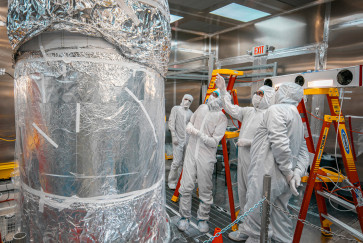
Dark matter detector picks up a mysterious signal
September 1, 2026

Northwestern announced in 2025 the launch of the Institute for Adolescent Mental Health and Well-Being, an interdisciplinary initiative to research issues related to the psychology and mental health of young adults and leverage its findings to benefit Northwestern students.
Leading the institute are Vijay Mittal, the David S. Holmes Professor of Brain Science and chair of the Weinberg College of Arts and Sciences’ psychology department, and Renee Engeln, a Weinberg psychology professor. The pair recently discussed adolescent brain development and what it means for supporting students.
Engeln: Working with you to launch the institute got me thinking about how I talk about teenage brains. For years now, when I teach the neuroscience section of Introduction to Psychology, I’ve shown my students an advertisement for Allstate insurance. It asks, “Why do most 16-year-olds drive like they’re missing a part of their brain?” The presumably tongue-in-cheek answer: “Because they are.”
Mittal: Does your class laugh?
Engeln: Yes, of course! And it helps them interrogate whether there’s truth to the claim that adolescents are basically adults with a big chunk of their brains missing.
Mittal: There’s something attractive about that argument because it feels like it captures why adolescents do some of the things they do: Driving too fast, staying up too late — impulsive, risky behaviors.
Engeln: They’re still growing in important ways.
Mittal: Adolescence is a time when the brain undergoes a massive amount of neural reorganization and growth, and this development goes on longer than most people think. It doesn’t end when you’re old enough to vote, or even when you’re old enough to drink. It continues until people are in their mid-20s.
Engeln: Our students don’t show up at Wildcat Welcome with adult brains.
Mittal: But they show up with something better. They show up with brains that are primed to do many of the things we hope they’ll do at Northwestern. Adolescent brains aren’t broken, they’re ready.
Engeln: When Northwestern began its faculty-in-residence program, I spent six years living in a faculty apartment in Allison Hall. I had a front-row view of adolescent brain development. I loved seeing students have fun, but they often had blind spots when it came to anticipating the outcomes of their actions.
Mittal: That makes sense given what we know about teen brains. In areas of the brain that respond to rewards, sensitivity to dopamine peaks during adolescence. That’s part of why teens tend to weigh potential rewards over risks.
Engeln: I’ve been really fascinated by recent research that helps us reframe adolescent dopamine sensitivity from a negative into a positive.
Mittal: Dopamine’s role gets oversimplified. Dopamine sensitivity plays a major role in supporting learning. It helps adolescents persist in the face of setbacks and approach problems with flexibility. Educators have a powerful opportunity to harness the unique state of adolescent brains, to guide adolescent boldness and flexibility so they turn into something positive. Research shows that hands-on and service-learning opportunities increase adolescents’ prosocial behaviors. That’s why Northwestern programs like Chicago Field Studies or the Center for Civic Engagement can be so formative for our students.
Engeln: The flexibility of adolescent brains also means we need to give young people space to interrogate their own values. Their brains are at a perfect developmental stage to solidify ideas about who they are and what they stand for. When adolescents’ risk-taking tendencies are guided by a well-developed value system, they can have positive outcomes.
Engeln: Let’s talk about another way we’re probably too hard on teenage brains. We criticize adolescents for being obsessed with the approval of others.
Mittal: Adolescence comes with increased activation in brain regions tied to social processing and threat detection, which makes teens exquisitely sensitive to social feedback. We’re quick to frame that sensitivity negatively, but it also bolsters social engagement.
Engeln: Young people are primed to build social connections, and we want those connections to be thoughtful and healthy. I’m thinking of the new Litowitz Center for Enlightened Disagreement and how it’s helping our students practice skills to manage disagreement with peers, holding on to social connections even when they’re difficult. Or the School of Education and Social Policy’s Marriage 101 class, where they learn the “how” of meaningful relationships. Adolescent brains are perfectly situated to benefit from these types of initiatives.
Mittal: Young brains flourish in environments that channel their drive for excitement, social sensitivity and cognitive flexibility.
Engeln: When I think about what those environments might look like, it’s a reminder that we need to be careful not to stifle young people or over-correct in our management of risk.
Mittal: We have to provide these young people with the resources to follow their creative impulses in positive ways. All that neural flexibility can turn into ingenuity if we give students the right support.
Engeln: I look at the theatrical and musical performances put on by our students, or the hundreds of independent research projects our students conduct each year. These aren’t the products of brains that are missing something fundamental.
Mittal: Exactly. Teenage brains are still developing, but they’re also overflowing with possibility and potential.