Dark matter detector picks up a mysterious signal
September 1, 2026

Northwestern University’s annual commemoration of the life and legacy of Dr. Martin Luther King Jr. paid tribute to King’s vision for a “Beloved Community.” The panel discussion between Northwestern faculty and community leaders in Galvin Hall on Jan. 20 broke down the concept, practice and possibilities of King’s vision before a live audience in addition to those watching via livestream.
The program was the centerpiece of a full week of commemoration events taking place on the Evanston and Chicago campuses.
The panel was moderated by Sylvester Johnson, chair and professor of Black studies, and panelists included Leslie Harris, professor of history; Kate Masur, John D. MacArthur Professor of History; Morris “Dino” Robinson, production manager at Northwestern University Press and founder of Shorefront Legacy Center; and Laurice Bell, executive director of Shorefront Legacy Center.
Provost Kathleen Hagerty offered welcoming remarks, and Nekesa J. Josey, whose grandfather, Lerone Bennett Jr., became the inaugural chair of Northwestern’s African American Studies department in 1972, provided an opening reflection, adding that each of us has a responsibility not only to choose whom we follow but also to examine the standards by which we live.
“We need a transparent criterion: character, courage and a willingness to act in the service of something larger than ourselves, said Josey, School of Professional Studies master’s student, where she is president of the Student Leadership Council. “Dr. King embodied that standard.”
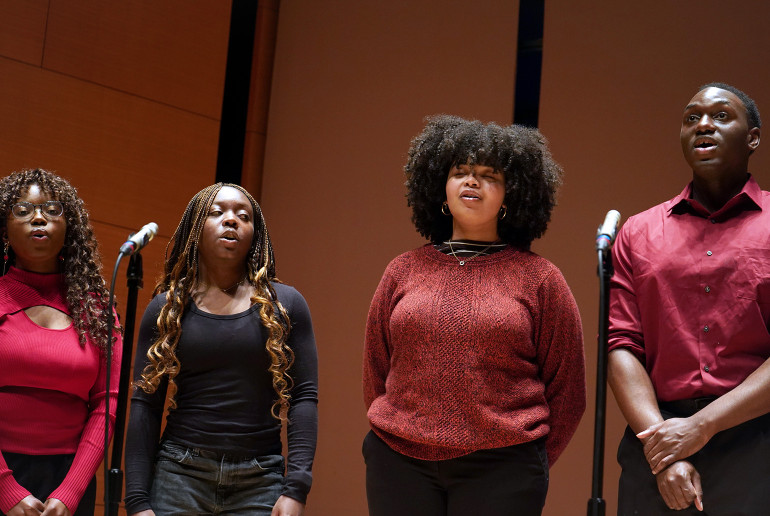
A cappella ensemble Soul4Real led the audience in “Lift Every Voice and Sing” prior to the panel taking the stage.
“For the first time, our keynote featured a panel of Northwestern faculty and Evanston community experts which perfectly embodied the theme of ‘Beloved Community,’” said Michelle Manno, associate provost of the Office of Community Enrichment. “Our goal was to highlight the incredible scholars and practitioners we have within our community who are thinking deeply about and working daily to realize King’s vision.”
Questions for the panel were submitted in advance by Northwestern community members and attendees and synthesized by Johnson as moderator. Northwestern Now has curated excerpts from the conversation.
What comes to mind when you think about Dr. King’s Beloved Community and the way you do your work?
“I think of family. And I’ll put this in a context of why I started Shorefront. I didn’t start it because I wanted to control or tell people’s stories. I wanted to learn what families have experienced. Even within the diversity of families, families can be at odds. But when it comes to bringing people together, we come to the same table, we eat, we share, we learn, we grow. And so, when I think about beloved community, it’s about all these difficult times, but how then we come together and rise above that.”
- Morris “Dino” Robinson, founder of Shorefront Legacy Center, and production manager at Northwestern University Press
What is the value of the broad public having a fuller understanding of Black history?
“I started working closely with the U.S. National Park Service out of a desire to make sure the history that people are now writing in academia is making its way to the public.
“Tons of people visit National Park Service sites every year — it is an important venue for telling historical stories. We needed to tell the story of Reconstruction, in particular, the story of the abolition of slavery in the United States, the first effort to create a multiracial democracy in the United States, the story of African Americans coming out of slavery and for the first time being able to make decisions about their own lives. All those stories that have been suppressed for so long, out of a desire to cover them over and also to cover over the white supremacist violence that brought that experiment down, and just out of neglect.
“I think it’s profoundly American to invest in education, to invest in research, to tell the truth, and to expect that people will come to grips with it. That’s exactly what is in danger right now.”
How do you see the connection between King’s legacy and contemporary issues?
“I think it’s really important to think of legacy and to recognize that we can’t raise King from the dead. And so, he gave us some ideas... But for the living, we have to decide where those legacies continue, what’s still useful, how do we make those legacies live? I think sometimes it’s not even the concept as much as how did he come up with it in the middle of a time that was as difficult a time we’re in now? Post World War II, figuring out human rights in the aftermath of a horrible genocide, figuring out what desegregation would look like and of course, the Cold War. There are many parallels.
“Everyone loves the ‘I Have a Dream Speech,’ but he wasn’t just about dreaming as we all know… There are so many hard things he said, particularly against the Vietnam War and at the end of his life about poverty. We sometimes forget the hard decisions that would have to be made to make those dreams live. Dreams of nonviolence, not just for protestors but for nations. So, I think we have a lot to do, and we’re living in a moment of great retrenchment, and we really have to question our leaders who sign on to this retrenchment.”
- Leslie Harris, professor of history
We are seeing pushback against hard won gains. What are some paths forward we should consider?
“We’ve always been in a fight. This isn’t new. It’s harsh, but it’s not new. Black community archives were ignored, and so we were able to go out there and talk to people and we were invisible. In terms of how we retrench, it’s what we’ve always been doing — we continue to collect the stories. We just did an intergenerational interview project with teens interviewing recipients of Reparations. It’s an extraordinary project. They both learn from each other. And within our first cohort, there were 12 individuals who were interviewed who’d received Reparations, five of those 12 within two years have passed away. Our history isn’t disappearing, but the firsthand ability to collect it is. I’ve hit the ground running, and I don’t think I’ll stop. And I hope that more of you will do the same thing.”
- Laurice Bell, executive director of Shorefront Legacy Center
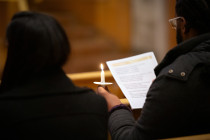
In addition to the keynote panel, 2026 MLK commemoration events included a candlelight vigil, Eva Jefferson Day, a discussion on homelessness and its connection to MLK’s activism and an oratorical contest.
The Office of Community Enrichment invites members of the Northwestern community to help shape the Future Archive: Our Beloved Community — a digital, community-built record of imagination, play and care. Learn more about how to participate.