Northwestern celebrates 22 years as a top Fulbright producer
February 4, 2026

Joel Mokyr, the Robert H. Strotz Professor of economics and history in the Weinberg College of Arts and Sciences at Northwestern University, was honored at the Nobel Prize ceremony with the Sveriges Riksbank Prize in Economic Sciences, a prize he shares with Philippe Aghion and Peter Howitt.
In the opening address at the Stockholm Concert Hall in Sweden on Dec. 10, Astrid Söderbergh Widding, chair of the Nobel Foundation, spoke to the serious problems the world currently faces but pointed to the hope symbolized by the assembly of 14 laureates.
“The Nobel laureates illuminate the world through knowledge, integrity and excellence,” Söderbergh Widding said. “They remind us of our responsibility and the possibilities that lie within our reach to transform the world into a better place for humankind.”
John Hassler, chair of the Nobel Committee for the Prize in Economic Sciences, introduced the three economic sciences laureates celebrated “for having explained innovation-driven economic growth,” and Mokyr specifically “for having identified the prerequisites for sustained growth through technological progress.”
Accompanied by a trumpet fanfare, Mokyr accepted his prize and diploma from King Carl XVI Gustaf of Sweden, and following Nobel protocols, bowed to the King, the Royal Family, his fellow laureates and finally the audience, which included his wife, Margalit, and members of his family.
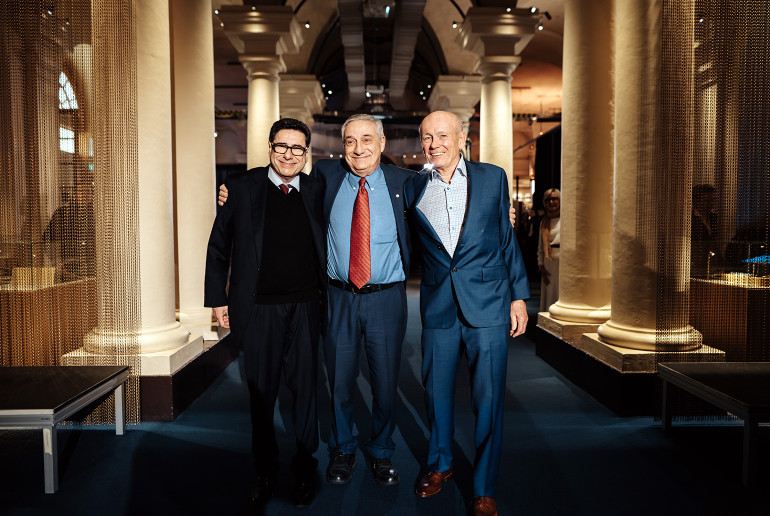
Mokyr was expected to make his acceptance speech at the Nobel Banquet later that evening, but earlier in the week, on Dec. 8, he presented his Nobel Prize lecture in economic sciences titled “The Past and Future of Innovation: Can Progress be Sustained?” arguing against diminishing returns on technological growth, aka “the curse of concavity.”
While some economists have theorized the lower hanging fruit of technological growth has already been picked and the greatest period of economic growth is behind us, Mokyr takes the opposite view.
“My argument is growth creates ladders, and high hanging fruits get easier to reach. And what’s more, the best fruits are at the top of the tree, and the tree is still growing,” Mokyr said.
“My bottom line on the future of technological progress and innovation is a simple and a very American expression: ‘You ain’t seen nothing yet, and the best is still to come.’ That is my message.”
Mokyr was awarded the Nobel Prize in Economic Sciences on Oct. 13. Mokyr received half of the prize for his development of a theory for sustained economic growth. Mokyr identified three important requisites for growth: useful knowledge, mechanical competence and institutions conducive to technological progress.
The other half of the prize is shared by Aghion of the Collège de France and the London School of Economics and Howitt of Brown University for their creation of a mathematical model for a theory of sustained growth through creative destruction. Howitt earned his doctorate in economics from Northwestern in 1973.