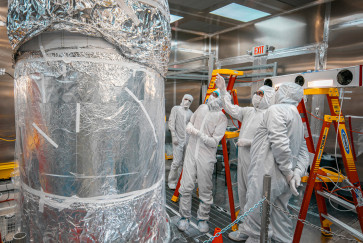
Dark matter detector picks up a mysterious signal
September 1, 2026
Elizabeth Horn and Xiaowei Wang have been named the 2026 recipients of the Alumnae of Northwestern University’s Award for Curriculum Innovation.
Horn’s curricular innovation is an experiential-learning course in which students will explore the application of theatre-based strategies with pediatric hospital patients. Wang will develop an advanced-level undergraduate course called Computing and the Environment that will explore the intersection of computing, environmental justice and climate.
Administered by the Office of the Provost, the award recognizes and supports faculty with innovative ideas for new courses, methods of instruction and enhancements to existing classes.
The award includes $12,500 in funding allocated for development expenses, stipends for the awardees and the faculty members’ home department.

Building upon introductory courses “Storytelling” and “Creative Drama” in the Theatre for Young Audiences module, Elizabeth Horn’s experiential-learning course will deepen student understanding of the challenges and opportunities in mounting theatre-based programming designed for a target demographic in non-traditional spaces.
In addition to creating a highly participatory, multisensory play that is responsive to the needs of each child, the class will include a survey of arts-based pediatric programming in the U.S. Two students will be accepted to travel to Atlanta, Georgia, to present about the course at the 2026 National Festival and Conference for Theatre for Young Audiences/USA in May.
Horn joined Northwestern in 2025. She specializes in theatre for young audiences and creative drama. Her interests include personal narrative and devised theatre, applied theatre, and arts and wellness.

Wang’s curricular innovation is an advanced-level undergraduate course called Computing and the Environment that will explore the intersection of computing, environmental justice and climate.
The class will offer an understanding of AI’s social and environmental impacts by having students build a solar-powered server, allowing them to engage with the infrastructural history of AI, see how AI tools and models like large language models (LLMs) rely on publicly available training data and how Web 2.0’s vast, user-generated content is essential for LLMs.
In creating a solar-powered web server, students also will directly investigate questions of data sovereignty, ethical data practices, the electrical grid intensity of websites, universal internet protocols and standardization, hardware utilization and e-waste.
Wang is a Mancosh Postdoctoral Scholar in the School of Communication. Xiaowei’s multidisciplinary work over the past 15 years sits at the intersection of public art, technology and social and environmental justice.