Northwestern celebrates 22 years as a top Fulbright producer
February 4, 2026

This winter, the Mary and Leigh Block Museum of Art at Northwestern University will present two exhibitions drawn from recent museum acquisitions of photographic portfolios. Both exhibitions, “Hamdia Traoré’s Des marabouts de Djenné and Muslim Portraiture in Mali,” and “Teresa Montoya: Tó Łitso (Yellow Water): Ten Years After the Gold King Mine Spill,” will be on view from Feb. 4 to July 14.
Each exhibition explores how contemporary artists use the medium of the extended photographic portfolio to tell a comprehensive story. The exhibitions also focus on artists documenting and interpreting the presentation of their own communities — Traoré focuses on Djenné, the historic center of Islamic learning in Mali, and Montoya on the riverways of the Animus and San Juan in the Southwest.
“These portfolios by Traoré and Montoya both demonstrate an intimacy that comes from proximity to the people and the stories they represent,” said Kathleen Bickford Berzock, associate director of curatorial affairs. “The visually stunning photographs draw us in. As viewers, we are invited through them into places and moments that most of us otherwise would not know. These two impactful portfolios speak to how our collection is expanding to represent global voices and artistic practices that resonate deeply with conversations across Northwestern.”
Traoré’s “Des marabouts de Djenné” extends the museum’s alignment with topics taught within the Programs of African Studies (PAS), Middle East and North African Studies (MENA) and the Herskovits Library of African Studies, among others. The series presents portraits of Muslim scholars and teachers, known as marabouts, from Traoré’s hometown of Djenné, a historic center of Islamic learning in Mali. The work also resonates with themes explored in The Block’s 2019 traveling exhibition “Caravans of Gold, Fragments in Time: Art, Culture, and Exchange across Medieval Saharan Africa.”
Montoya’s “Tó Łitso (Yellow Water)” contributes to University-wide dialogues around Indigenous studies and environmentalism, including ongoing Block partnerships with the Center for Native American and Indigenous Research (CNAIR) and the Climate Crisis + Media Arts working group. Her portfolio traces the path of contamination following the 2015 Gold King Mine spill, reflecting on its cultural and ecological aftermath for Diné and other Indigenous communities in the American Southwest. The exhibition also continues conversations that were part of The Block’s 2025 exhibition “Woven Being: Art for Zhegagoynak/Chicagoland.”
“The Block is honored to be the home for these important portfolios, and we look forward to rich discussion of the artists’ work across Northwestern,” said Lisa Corrin, the Ellen Philips Katz Executive Director of The Block Museum of Art.
“It was important for us to present these portfolio series in their entirety, in close collaboration with the artists themselves. A complete photographic portfolio offers a fuller picture of an artist’s subject and practice. Presenting the works in sequence invites viewers to follow the artist’s thinking across time and place. These photographic series will become lasting resources for students, offering opportunities to study how artists can construct meaning through sustained engagement with their subjects,” Corrin said.
The storied city of Djenné, a center of Islamic learning and scholarship since the 12th century, is the hometown of Bamako-based photographer Hamdia Traoré (b.1992, Mali). His series “Des marabouts de Djenné (Marabouts of Djenne)” comprises 30 portraits of “marabouts,” whose work sustains the city’s intellectual and spiritual traditions.
Made between 2018 and 2023, Traoré’s portraits capture his subjects onsite within the spaces of their work, seated with the tools of their practice — Qur’ans, writing boards, amulets and prayer beads. Created amid a period of political and social upheaval in Mali, these images reflect endurance, devotion and continuity.
“I want viewers to know who these marabouts are — teachers with schools, men of learning and care,” Traoré said. “By photographing them where they work and teach, I am preserving their presence for today and for the future.”
“Des marabouts de Djenné” marks Traoré’s first solo exhibition in the U.S. His work will be shown alongside mid-20th-century, black-and-white portraits of marabouts by Mamadou Cissé, Abdourahmane Sakaly, Tijani Sitou and Félix Diallo drawn from the Archive of Malian Photography in collaboration with the artists’ studios. Seen together, these historical and contemporary images evoke representations of faith, identity and authority in Malian visual culture over time.
Hamdia Traoré is a documentary photographer based in Bamako, Mali. His photographs have been exhibited both in Mali and abroad. He has worked as a photographer and videographer for the United States and British embassies in Mali and the Consulate of Monaco in Mali, as well as for international NGOs, including SPANA, Tree Aid, Sightsavers, DevWorks, Vétérinaire Sans Frontières Belgium and the Organization for the Prevention of Blindness. He is also affiliated with the photo agency Andolu Images. In 2015, he received the Documentary Award in the architecture category from the Humanity Photo Awards of the China Folklore Photographic Association.
The exhibition of Hamdia Traoré’s portfolio was developed in collaboration with the artist and Candace M. Keller, associate professor, art history and visual culture, Michigan State University and co-founder of the Archive of Malian Photography. At The Block, the exhibition is supported by the Kadin/Spiegel Family Endowed Fund and a grant from the Illinois Arts Council.
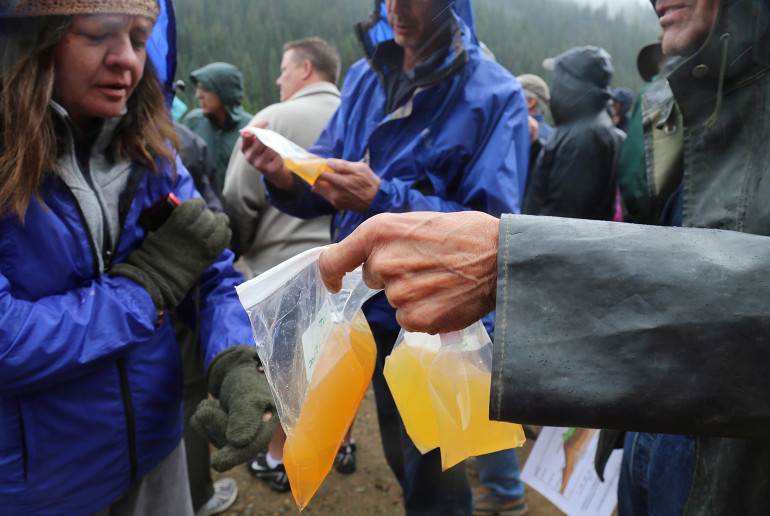
On Aug. 5, 2015, the rupture of the abandoned Gold King Mine near Silverton, Colorado, released more than three million gallons of toxic wastewater into the Animas River, turning its waters as well as that of the San Juan River and its other tributaries, a shocking yellow. In 2016, artist and anthropologist Teresa Montoya (Diné, born 1984) embarked on a journey from Silverton to Shiprock, New Mexico, tracing the path of the contamination and documenting its ongoing cultural and environmental impacts.
This year marked the 10th anniversary of the disaster. Through The Block’s exhibition, Montoya is revisiting that journey through the photography, sound recordings, water samples and cartographic data she compiled between 2016 and 2019. Combining photo documentary and poetic approaches, Montoya’s work reflects on the enduring presence of toxicity across landscapes and the intertwined relationships between people other-than-human beings, and water.
By centering Indigenous knowledge systems and acts of resilience, Montoya challenges extractive frameworks and invites reflection on environmental justice in the Southwest and beyond.
“Sometimes it appears beautiful, other times haunting,” Montoya explains. “The images highlight the relationships that various communities sustain through water (“tó”) — despite repeated contamination from upstream locales. The Gold King Mine spill makes this visible, even when the harm itself is not.”
This work was previously featured in conjunction with the “Spill” exhibition shown at the Morris and Helen Belkin Art Gallery at the University of British Columbia. “Tó Łitso (Yellow Water): Ten Years After the Gold King Mine Spill” marks Montoya’s first solo exhibition in Chicago.
Teresa Montoya (Diné) is a photographer, social scientist and assistant professor in the department of anthropology at the University of Chicago. Her research and creative practice focus on contemporary problems of environmental governance in relation to historical legacies of land dispossession and resource extraction across the Indigenous Southwest. Her work has been published in the American Journal of Public Health, Anthropology Now, Cultural Anthropology, Journal for the Anthropology of North America, Ecology and Society, Environment and Planning E: Nature and Space, Visual Anthropology Review, and Water International. She has curatorial experience in various institutions, including the Field Museum where she served as a guest curator for “Native Truths: Our Voices, Our Stories.” She is the founding member of Diné in Focus, a collective dedicated to Diné photojournalism through a Diné lens.
The Block Museum of Art, free and open to all, is located at 40 Arts Circle Drive, Evanston. For more information and the schedule of events visit the Block Museum website.
Lindsay Bosch is associate director of communications, marketing and digital strategy for The Block.