Dark matter detector picks up a mysterious signal
September 1, 2026
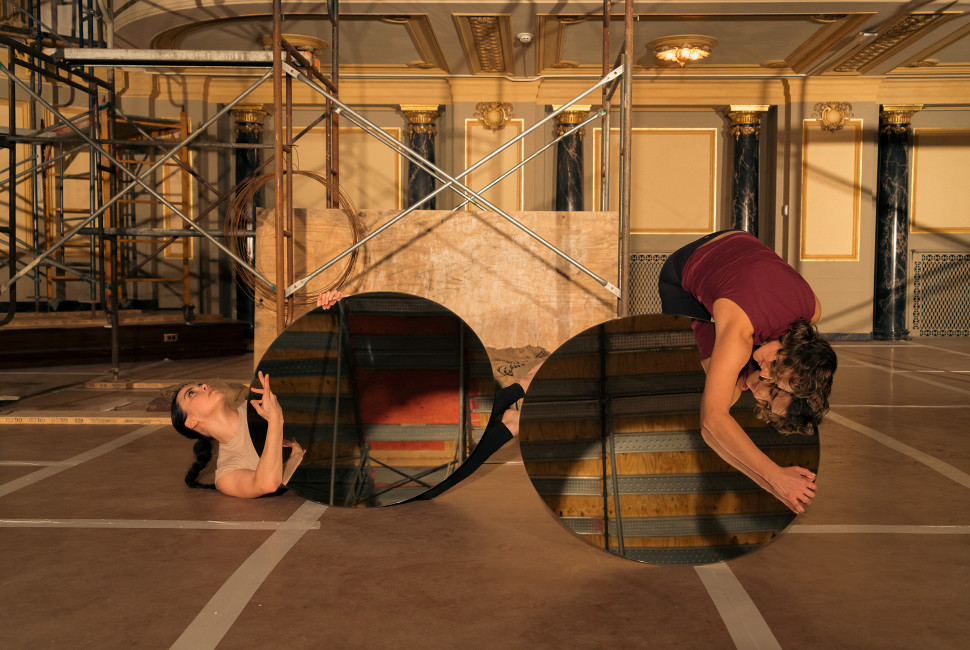
Brendan Fernandes, an internationally recognized performance and visual artist who sees himself as a “complicating factor” in an art world that often relies on fixed categories, is having a milestone year.
Since arriving 10 years ago to teach in Northwestern’s art theory and practice department, he’s gotten tenure and taken roles on the board of directors at various Chicago cultural institutions including the Joffrey Ballet and Arts Alliance Illinois. His civic engagements have cultivated a wide range of artistic collaborations, creating new opportunities for public audiences and his students.
As the first artist-in-residence at Chicago’s Driehaus Museum, Fernandes has been given access to a landmark space for a yearlong period. The residency gives him time to adapt and respond to the space, while developing new site-specific works with his collaborators. He is also inviting other artists with a curated program of performances and giving his dancers time to develop their own work. Looking ahead to fall 2026, he hopes to hold classes and provide opportunities for graduate students in the critical dance studies cluster to present lectures on their research to the Chicago dance community and beyond.
Fernandes makes work at the intersection of visual arts, dance, sound, film and architectural interventions. “We all carry complexities within our identities,” said Fernandes who identifies as “Kenyan Indian Goan who is Canadian-slash-American.” “That’s what I value in my work, it doesn’t have to be one thing. It exists in a constant state of flux and becoming.”

His residency at the Driehaus is the latest example. “As a queer-identifying artist and person of color, I think deeply about how to create new forms,” Fernandes said. “For me, queerness extends beyond the binaries of gender and sexuality. It is about inclusivity, and about imagining new ideas and new ways of being.
“When I enter a museum space, my hope is to challenge it to do things it hasn’t done before — that’s very important to me. It’s equally important that the museum trusts me to enter that space and make those possibilities happen,” Fernandes said.
The Driehaus Museum occupies a late 19th-century mansion on the National Historic Places registry. Restored to its Gilded Age splendor by philanthropist Richard M. Driehaus, it opened to the public in 2008 as a museum showcasing Art Nouveau furnishings, Tiffany glass objects and other American and European decorative arts of the late 19th and early 20th centuries.
Fernandes said the ornateness of the Driehaus Museum is distinct from his past museum residencies.
“The opulence feels special to perform within,” he said. “I approach it as a sanctuary, one that offers space for contemplation, particularly in the auditorium where I’m working.”
Fernandes wants to provide a restorative experience for audiences. The durational nature of the performances, which last for a period of three hours, invites audiences to stay as long as they would like and return to see how the work changes.
“In the times we are living in, stopping can be a form of protest, an act of regeneration. People march in the streets to have their voices heard, but we also need moments to pause, to care for ourselves, to check in, and to release,” Fernandes said. “Finding empowerment and joy from within is its own form of protest, one that allows us to regenerate so we can continue the work and move forward.”
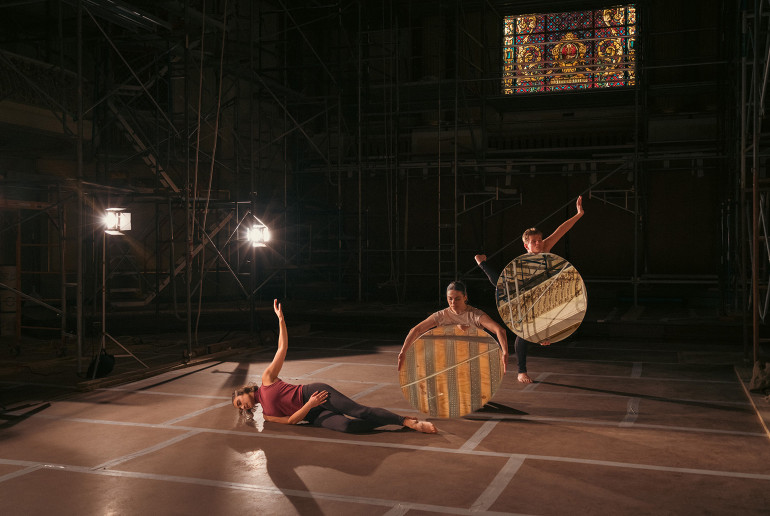
“Score for the Murphy Auditorium” marks the first public performance of his residency. It will feature a sound installation by Alex Inglizian, professor of sound arts and industries at Northwestern’s School of Communication. It includes a rotating cast of dancers who will interact with site-specific installations and textiles developed in collaboration with AIM Architecture and The Fabric Workshop and Museum.
Incorporated into the piece are mirrors which Fernandes says speak to visibility and a space in transition.
“There is a sculptural bench made of mirrors that echoes the shape of the oculus in the ceiling dome. As dancers move, or as viewers walk through the installation, it disrupts the architecture of the space, reflecting and multiplying the bodies within it to challenge ideas of visibility,” Fernandes said.
Rather than watching the dancers on a proscenium stage from the auditorium seats, which is the Western way of looking, the audience will be on the stage watching the dancers.
“Because the proximity is challenged, you will be able to see the dancers breathing and see everybody in the round,” he said. “There’s also a balcony where people can stand and watch from above. You might see yourself in the mirror.”
Returning to the idea of protests, Fernandes said, “It’s not only about changing how we are perceived, seen and heard, but also about challenging existing structures to make them more accessible and inclusive.”
The world premiere of “Brendan Fernandes: Score for the Murphy Auditorium” will take place as part of EXPO Chicago, Friday, April 10 from 6 to 9 p.m. in the newly restored 1926 Murphy Auditorium of the Driehaus Museum, 50 E. Erie Street. For the schedule of “Brendan Fernandes: In the Round” events visit the Driehaus Museum website.